



-
Sold out


Gastone Rinaldi dining chairs covered with original cow leather, set of two, Italy, 1960s
Sold ItemsBeautiful set of dining chairs designed by Gastone Rinaldi. The pairs has a frame made of chrome and features the original dark brown cow leather. The chairs are made in Italy in the 1960s. They are in good vintage condition showing just small visible traces of a regular use. Nota bene: The chrome frame (silver colored) is in good condition and may look different in the photos due to reflections.600 €600 € -
Sold out


Danish Daisy Pendant by Anton Michelsen
Sold ItemsDaisy pendant by Anton Michelsen, Denmark, D=3.4 cm, 9,08 g, 1960s (Gilt sterling silver & enamel, marked AM under the crown in a triangle, STERLING DENMARK, 925S). Designed in 1940 to celebrate the birth of Margrethe Princess (now Queen Margrethe II of Denmark) by Anton Michelsen, the lovely daisy is made of gilt sterling silver and ehite enamel. The daisy is the national flower of Denmark.185 €185 € -
Sold out


Jules Perahim, Personnages surréalistes, lithograph ex. 17/40, lithograph Michel Casse, signed, dated (19)81
Sold ItemsJules Perahim (born Iuliș Blumenfeld) was a Romanian artist of Jewish origin. After being associated with Surrealist circles at the beginning of the 1930s, he has contributed to the early development of what was to become Socialist Realism. In spite of the success he gets during the Communist regime, he grows frustrated by the lack of artistic liberty and, at some point during the 1960s, leaves the country to settle in Paris, where he continues to paint in surrealist style350 €350 € -
Sold out


Space Age Bubble Glass Bedside Table Lamp from Hawill, 1960s, set of two
Sold ItemsThese lovely lamps from the 60's have a typical look to the Mid Century design with a rectangular base made of cream-white and red plastic and the bubble glass lampshades colored in a smoky brown tint. Emitting a warm light, the lamps create a vintage atmosphere as pleasant as it is restful. Fully functional, the lamps are in very good vintage conditions. E14 bulbs is not included. Dimensions (HxWxD): 25x9x12 cm; Lenght cord: 110 cm ; Weight: 575 g (each) Even if the lamps work they are a vintage items, so we recommend that it be checked by a specialist before use. The items colour may slightly vary due to photographic lighting sources, sales platform settings or your monitor settings. For a more conclusive idea please see the detail pictures or ask for details. Thanks for your visit!230 €230 €
-
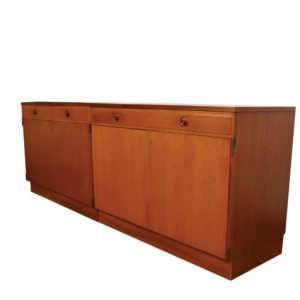
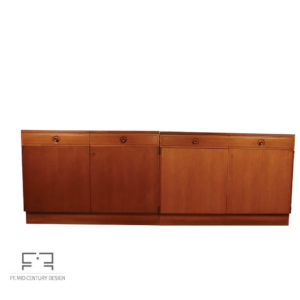
Swedish sideboard in teak by Bertil Fridhagen for Bodafors, 1960s, set of 2
Furniture, StoragePair of Scandinavian Modern sideboards in teak, designed by Bertil Fridhagen for Bodafors, Sweden, in 1960s. Both sideboards have two drawers at the top, and at the bottom one has two compartments with adjustable shelves and the other a records compartment and a compartment with a height-adjustable shelf. There are original keys for both sideboards. The items are in good vintage condition with light wear consistent with age and use. Elegant, refined, proving the excellence of the Scandinavian design, the two pieces fit both the sumptuous interiors and the minimalist ones, as design accents.800 €800 € -


Danish Modern recliner armchair with folding footrest, 1960s
Furniture, SeatingThis armchair for reading or watching TV is particularly comfortable, especially when extended and you can rest your feet on the foldable footrest. The armchair is in overall good vintage condition, with normal signs of wear. Please note that we can reupholster the armchair according to your preference, so please contact us if you wish this.450 €450 € -


GS195 Gianni Songia Daybed in Navy Blue Andrew Muirhead Fine Scottish Leather, Italy, 1963
Furniture, Seating, TrendsThis glamorous three-seat daybed and sofa was designed by Gianni Songia for Sormani, Italy, in 1963. Model GS-195 with leather cushions. The elegant frame is built from rosewood and can be used as an extremely comfortable three-seat sofa with adjustable backrest. The backrest can also slide backwards which then transforms the piece into a comfortable bed. The frame is in good vintage condition with minimal signs of wear and preserved the original springs net (the elasticity of the springs net has been strengthened and now is very comfortable). The original cushions have been reupholstered with a beautiful pale Navy Blue Fine Leather from Andrew Muirhead & Son, Scotland. Elegant, refined, proving the excellence of the Modernariato Italian design, this eye-catcher and mood maker piece fit both the sumptuous interiors as central pieces, and the minimalist ones as design accents.3.500 €3.500 € -

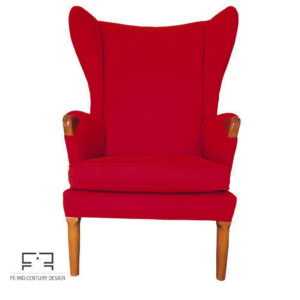
Impressive armchair 757 Parker Knoll Wingback, 1960s
Furniture, SeatingWingback armchair model 757 made by Parker Knoll in the UK in the '60s. The armchair - fully restored - has a red fabric upholstery which contrasts nicely with the oak wood at the armrests and legs. Very comfortable, with an imposing shape, this beautiful piece will easily attract the viewer's attention, being suitable in any interior, be it classic or modern. Items color may slightly vary due to photographic lighting sources or your monitor settings. For a more conclusive idea please see the detailed picture of the fabric. If you need additional information, do not hesitate to contact us.900 €900 € -


Elegant and rare dining chairs by Miroslav Navratil, made in former Czechoslovakia, 1960s, set of 4
Furniture, Seating, TrendsElegant and rare set of 4 dining chairs designed by Miroslav Navratil and made in former Czechoslovakia in the 1960s. The chairs feature a clean, geometric, minimalistic design. The upholstery is made of purple fabric and black faux leather. The set is in good vintage condition with only minor signs of use (see photos).950 €950 € -
Sale


Sputnik chandelier with 8 Opaline lampshades, Stilnovo Style, 1950s, IT
Ceiling Lights, Lighting, Special DiscountsSpectacular and exquisite ceiling lamp made in Italy in the 1950s. This item is characteristic for the beautiful Stilnovo that touched the Italian design in the 40s and made Italian designers famous for their Mid-Century lighting fixtures. The lamp is made of brass (and white painted brass). The lampshades are made of Opaline. The piece is kept in good condition and is in full working order. Kept in good vintage condition, it shows just minor traces of use consistent with it's age (all visible in the photos).500 €500 € -


British model PK988/1023 armchairs from Parker Knoll, 1960s, set of two
Furniture, SeatingEnglish Mid-Century Modern model PK988/1023 (upholstered back) wood framed armchairs/lounge chairs from Parker Knoll, set of two. The armchairs were newly reupholstered and are in a very good vintage condition (with all the minor defects visible in the pictures). The model is iconic for British Modern design and is highly inspired from the Danish Modern lines of that period. Each armchair has its original Parker Knoll stamp.700 €700 € -
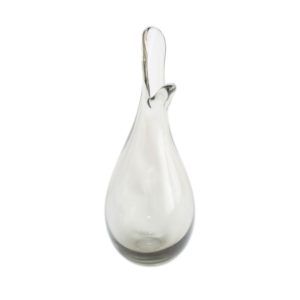

Beautiful Næbvase (Duckling or Beak vase) by Per Lütken
Glass & Ceramics, Home AccessoriesSpectacular vase from the famous Næbvase (Duckling or Beak vase) series, signed by Per Lütken and produced at Holmegaard. A very exquisite piece, which was appreciated since the beginning for its supple, organic and soft shape. Signed, identified and dated on the bottom, “Holmegaard 19PL55” (Per Lütken signed almost always monogrammed with initials falling between the 4 digits of the year). The Næbvase (Duckling or Beak vase) series was in production between 1952 and 1974.100 €100 €



The 1950s were marked by optimism, by rebirth, by the desire for a better, snug life. It is then no wonder that today, in the rush of the 21st century, we openly, admiringly and nostalgically look back to the atmosphere of those days.


About Mid-Century
Mid-century modern is an architectural, interior, product and graphic design that describes mid-20th century developments in modern design, architecture and urban development from roughly 1933 to 1965. The term, employed as a style descriptor as early as the mid-1950s, was reaffirmed in 1983 by Cara Greenberg in the title of her book, Mid-Century Modern: Furniture of the 1950s (Random House), celebrating the style that is now recognized by scholars and museums worldwide as a significant design movement. The Mid-Century modern movement in the U.S. was an American reflection of the International and Bauhaus movements, including the works of Gropius, Florence Knoll, Le Corbusier and Ludwig Mies van der Rohe. Though the American component was slightly more organic in form and less formal than the International Style, it is more firmly related to it than any other. Brazilian and Scandinavian architects were very influential at this time, with a style characterized by clean simplicity and integration with nature. Like many of Wright’s designs, Mid-Century architecture was frequently employed in residential structures with the goal of bringing modernism into America’s post-war suburbs. This style emphasized creating structures with ample windows and open floor plans, with the intention of opening up interior spaces and bringing the outdoors in. Many Mid-century houses utilized then-groundbreaking post and beam architectural design that eliminated bulky support walls in favor of walls seemingly made of glass. Function was as important as form in Mid-Century designs, with an emphasis placed specifically on targeting the needs of the average American family. In Europe the influence of Le Corbusier and the CIAM resulted in an architectural orthodoxy manifest across most parts of post-war Europe that was ultimately challenged by the radical agendas of the architectural wings of the avant-garde Situationist International, COBRA, as well as Archigram in London. A critical but sympathetic reappraisal of the internationalist oeuvre, inspired by Scandinavian Moderns such as Alvar Aalto, Sigurd Lewerentz and Arne Jacobsen, and the late work of Le Corbusier himself, was reinterpreted by groups such as Team X, including structuralist architects such as Aldo van Eyck, Ralph Erskine, Denys Lasdun, Jorn Utzon and the movement known in the United Kingdom as New Brutalism. Pioneering builder and real estate developer Joseph Eichler was instrumental in bringing Mid-Century Modern architecture (“Eichler Homes”) to subdivisions in the Los Angeles area and the San Francisco Bay region of California, and select housing developments on the east coast. George Fred Keck, his brother Willam Keck, Henry P. Glass, Ludwig Mies van der Rohe, and Edward Humrich created Mid-Century Modern residences in the Chicago area. Mies van der Rohe’s Farnsworth House is extremely difficult to heat or cool, while Keck and Keck were pioneers in the incorporation of passive solar features in their houses to compensate for their large glass windows. (source: wikipedia.org)