
-


Vintage bedside table lamp made in Germany, 1980s
Lighting, Table LampsBeautiful bedside table lamp with globular body made of beige glazed ceramic and brown lampshade with light fixture. The design of the lamp is a classic, simple and elegant one, specific to the Mid Century era. The lamp gives a warm, pleasant and restful light. Fully functional, the lamp is in very good vintage conditions. E14 bulb is not included. Dimensions (HxWxD): 18x11x11 cm; Lamp Body (HxWxD): 9x9x9 cm; Lampshade (HxWxD): 10x11x11 cm; Lenght cord: 110 cm ; Weight: 500 g Even if the lamp work it is a vintage item, so we recommend that it be checked by a specialist before use. The item colour may slightly vary due to photographic lighting sources, sales platform settings or your monitor settings. For a more conclusive idea please see the detail pictures or ask for details. Thanks for your visit!40 €40 € -
Sold out


Ceramic orange glazed table lamp made in Denmark
Sold ItemsBeautiful ceramic table lamp made in Denmark in the 1960s. The base lamp, made of ceramic, is distinguished by the play between the vivid orange glazed top and the naked clay (without glaze) brown bottom. Both the color and the technique are specific to the period. The piece is kept in a very good condition, without visible defects and has all it's original elements (lightbulb socket, switch, electric cord, plug).100 €100 € -
Sold out

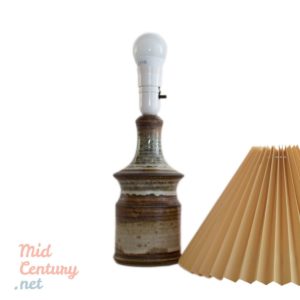
Very rare stoneware table lamp handmade by Joseph Simon for Soholm Stentoj
Sold ItemsVery rare stoneware table lamp designed and handmade by Josef Simon for Søholm Stentøj, Denmark, in the 1960s. The body, made of glazed ceramic, is remarkable due to its exquisite circular decoration in colors that speaks about earth, sand and sky. The lamp is signed on the bottom, "Simon", has the Søholm Stentøj mark, the production number and also a "handmade" stamp, not to mention that Søholm Stentøj is not a lights factory but a ceramic art studio that values the design and quality. The lamp is in very good condition. An extremely rare and refined piece of Danish Modern design. Denmark has a rich tradition of producing Fine ceramics and original pottery dating back several hundred years and one of the greatest was Søholm. Søholm was founded in 1835 and is the oldest ceramic factory in Bornholm, a Danish island famous for its pottery and fine ceramics artisans. The pottery from the 1950s-1960s is often characterized by the sleek lines, streamlined design and innovative use of materials - just as the famous Danish Mid-Century Furniture. The factory closed in 1996.100 €100 € -
Sold out


Elegant ceramic table lamp made by Soholm Stentoj
Sold ItemsBeautiful ceramic table lamp designed by Einar Johansen and produced by Søholm Stentøj, Denmark, in the late 1960s. The body, pear-shaped, is remarkable due to the simplicity of line and earthy colors. Søholm Stentøj is not a lights factory but a ceramic art studio that values the design and quality. The lamp is in very good condition. Einar Johansen was a Danish ceramicist, who trained as a painter at the Royal Danish Academy of Fine Arts in Copenhagen, but later changed his mind and became a pottery maker. He had his own pottery in the period 1935-1958. He was employed at Søholm in the period 1958-1968, and designed several, beautiful stoneware and pottery – among these, his famous blue glazed stoneware. He worked for Knabstrup (a Danish Pottery) in the early 1970s. Søholm Stentøj was founded in 1835 by Edvard Christian Sonne and Herman Sonne Wolffsen in Bornholm, Denmark. The factory closed in 1996.100 €100 € -
Sold out

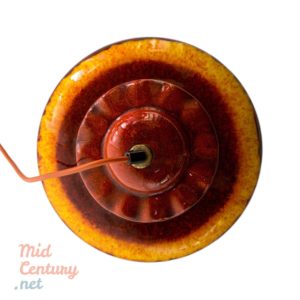
Atomic Age ceramic ceiling lamp made in Germany
Sold ItemsAtomic Age pendant ceiling lamp made in Germany, in the late 1960s or early 1970s. The lamp shade is made of glazed ceramic. The vivid colors (of earth and fire), the organic lines and the circular shape, all shows the influence of the Atomic/Space Age aesthetics. The cord is adjustable. Atomic Age in design refers to the period roughly corresponding to 1940–1960 and extending in the 1970s, when concerns about nuclear war dominated Western society during the Cold War. The discovery and development of the Electron microscope had also a huge impact. Architecture, industrial design, commercial design (including advertising), interior design, and fine arts were all influenced by the themes of atomic science, as well as the Space Age, which coincided with that period. Atomic Age design became popular and instantly recognizable, with a use of atomic motifs and space age symbols. Retrofuturism is a current resurgence of interest in Atomic Age design. Free-form organic shapes also appear as a recurring theme in Atomic Age design, reflecting x-ray technology that was becoming more widespread and familiar in pop culture. These botanic designs influenced later Atomic Age patterns that included repeating organic shapes similar to cells and organisms viewed through a microscope. Vital forms, or abstract organic forms, were identified as a core motif.100 €100 €

Ceramic glaze
Home » Ceramic glaze