
-
Sold out


Rare Pyramide dining table with top glass and chromed base by Rudi Verelst for Novalux, Belgium, 1970s
Sold ItemsRare and elegant Pyramide dining table designed by Rudi Verelst and manufactured in Belgium, in the 1970s, by Novalux, Belgium. It features a circular table top made of glass resting on a chrome tubular pyramid base extending into a smaller inverted pyramid shape. The table is in good vintage condition.600 €600 € -
Sold out


Elegant Art Deco hallway stand made of brass, 1950s, Germany
Sold ItemsElegant Art Deco hallway stand made of brass in 1950s in Germany. The stand has two brass shelfs and a top made of black glass. With a geometric and minimalistic look, this Art Deco piece of furniture is very light and will be an non-intrusive yet chic presence in any hallway. The item is in good vintage condition.75 €75 € -
Sold out


Space Age ball ceiling lamp by Richard Essig, 1970s, DE
Sold ItemsBeautiful ceiling lamp made in Germany in the 1970s. The item is designed by Richard Essig following the aesthetics of Space Age design. The lamp is made of plastic and glass and features some really nice orange accents. The piece is kept in good condition and is in full working order.200 €200 € -
Sold out
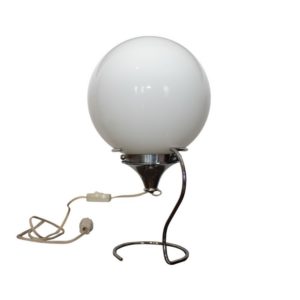

Pop table lamp made in France, in the 1970s
Sold ItemsSuave and elegant globe table lamp made in France in the 1970s. With a minimalist design, this lamp features a spiral, discrete metal support as a lamp base. The opaque white globe falls both into Pop and Atomic Age aesthetics. The lamp has it's original electrics, including the plug and the switch.150 €150 € -
Sold out


Murano sommerso vase from the 1950s
Sold ItemsBeautiful Murano sommerso vase in green and purple. The piece is made in the 1950s and is kept in very good condition, showing no visible deterioration. It has the original label. When thinking of Murano glass, it is highly unlikely that we think of sand, yet this rare material is at the base of all glass production. Glass is firstly a mix of siliceous sand, soda, lime and potassium, which is put to melt inside an oven at a temperature of around 1.500 Celsius. After it has become flexible enough, it is removed with a pipe that will be used to blow the glass out while the glassmaker shapes and models it. The forms and colors given to each piece depend on the tools and chemicals used during its production. The techniques are also important.. One of the most common techniques is “Sommerso”, which in Italian literally means “submerged”. This technique is used to create several layers of glass (usually with different contrasting colors) inside a single object, giving the illusion of “immersed” colors that lay on top of each other without mixing. This is done by uniting different layers of glass through heat and repeatedly immersing them in pots of molten colored glass. This technique is quite recognizable: it is characterized by an outer layer of colorless glass and thick layers of colored glass inside it, as if a big drop of color had been captured inside the transparent glass. When one first sees these objects, it seems almost impossible to conceive such beautiful colors being locked so perfectly inside what would seem solid glass, and then undoubtedly one begins to wonder how ever did they manage to achieve such a complex game of shapes and colors right in the middle of a clear glass object. Source: glassofvenice.com75 €75 € -
Sold out
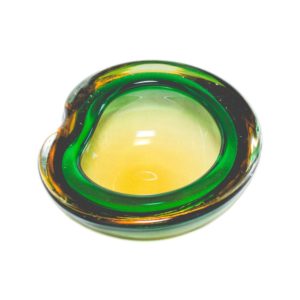

Green and brown bowl made in Murano, in the 1950s
Sold ItemsBeautiful geode bowl made in Murano, Italy, in the 1950s. Nicely colored, in shades of brown and green, this is a hand blown piece kept in very good vintage condition. Murano glass Geode bowls earn the name "geodes" due to their resemblance to geode rocks - rocks or stones that have been sliced neatly in two. The geode bowls therefore have a perfectly flat, wide rim. Murano glass geodes consist of two or more layers of cased glass. They were made my several Italian glass manufacturers from the Venetian island of Murano, and as such it is virtually impossible to identify the maker of an unmarked bowl. Popular geode shapes include circular, square, triangular, figure eight, and kidney shaped among others. Source: 20thcenturyglass.com50 €50 € -
Sold out


Imposing emerald fruit bowl made in Murano in the 1970s
Sold ItemsImposing emerald fruit bowl made in Murano in the 1970s. This tall, massive, beautifully colored piece is in very good vintage condition, showing no visible defects. During World War II the industry did not thrive, but as soon as the war was over the glass masters of Murano returned to their art and created pieces deeply rooted in interior design trends of that time with focus on minimalism, functionality, and simplicity. To support these trends Murano artists and artisans returned to techniques of the past such as filigree, murrino, and lattimo. From that point onwards Murano saw continued exploration of styles and techniques striving to find a happy medium between the technical mastery and the outline, color, and decoration. The resulting continuous innovation led to a rise in popularity and to multiple prizes at various international art exhibitions. Thanks to such prominent artists as Archimede Seguso, Ludovico and Laura De Santillana, Tobia Scarpa, Ercole Barovier, Fulvio Bianconi, Toni Zuccheri, Romano Chrivi, Giampaolo Martinuzzi, and Alfredo Barbini, Murano again became known as the glassblowing capital of the world. Murano now created the art trends as opposed to following them in the years past. Source: glassofvenice.com100 €100 € -
Sold out
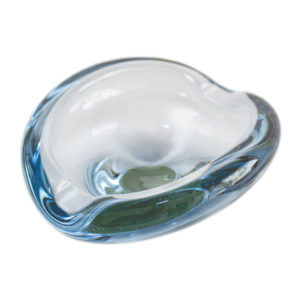

Beautiful Akva ashtray for two, by Per Lütken
Sold ItemsBeautiful Akva ashtray for two designed by Per Lütken for Holmegaard. This model is part of the Akva series, which was a huge success and remained in production for more than two decades between 1953 and 1974. A rare piece made from hand-blown glass. The Akva series includes items sold under different trade marks and line names: Askebaeger, Dukling, Fiona, Hellas, Lysestage, Menuet, Rondo, Selandia, Thule, Umanak, Surf etc.50 €50 € -
Sold out

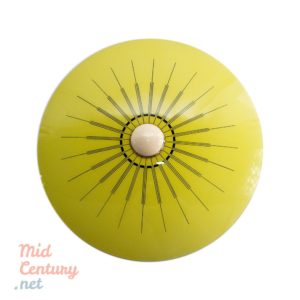
Space Age UFO ceiling lamp made in Germany, in the 1960s
Sold ItemsSpectacular UFO Space Age ceiling light made in Germany, in the mid 20th century. The light consists of two plates of yellow glass with geometric decorations (black lines). Made in the 1960s and resembling an UFO, this is a representative piece fort the aesthetics of the Space Race era. The Space Age is a time period encompassing the activities related to the Space Race, space exploration, space technology, and the cultural developments influenced by these events. The Space Age is generally considered to have begun with Sputnik (1957). During the 1950s, architecture, furniture, interior design, cars, and gadget design took on a curiously spaceflight-inspired aesthetic.220 €220 € -
Sold out


Model 5614 – shades teak, glass top – Trinity nest from Nathan, 1960s, set of 3
Sold ItemsSet of Trinity nesting tables from Nathan. The set consists of a large coffee table (with a glass top) and 3 small tables. The tables are made of teak and are in very good vintage condition. The Nathan Classic Shades and Editions ranges all work to capture the essence of timeless design.. The natural variation in color and grain which is the beauty of real wood gives every piece of Nathan Furniture its own distinct character.450 €450 € -
Sold out

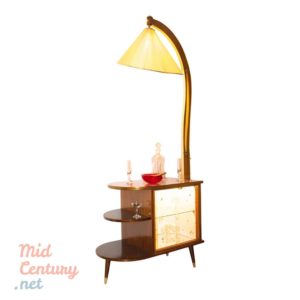
Spectacular Art Deco minibar
Sold ItemsSpectacular Art Deco minibar produced in Hungary sometime between WW1 and WW2. The bar has its own lights, one attached on the side and one inside the glass case. This is definitively an elegant and discreet piece, with simple lines and geometric shapes. The glass case has an intermediary glass shelf and is upholstered. The brass inserts and shoes are also representative for the interwar aesthetics. The minibar is in very good condition and was recently restored: the lampshade, damaged by time, has been changed (keeping the original metal frame) and the wood was re-stained in the original color.400 €400 € -
Sold out


Beautiful Space Age / Atomic Age ceiling lamp with 5 lights
Sold ItemsBeautiful ceiling lamp made in the 1970s. The piece is representative for Space Age/Atomic Age Design. It has 5 lights with spherical lampshades, diametrically arranged around a central axis made of dark brown metal. Simulating as the model of an atom (or, more precisely, of how electrons gravitate around the nucleus), this is a very beautiful piece and is in very good vintage condition. The Space Age is a time period encompassing the activities related to the Space Race, space exploration, space technology, and the cultural developments influenced by these events. The Space Age is generally considered to have begun with Sputnik (1957). During the 1950s, architecture, furniture, interior design, cars, and gadget design took on a curiously spaceflight-inspired aesthetic.200 €200 € -
Sold out


Stainless steel coffee table with a newspaper stand
Sold ItemsBeautiful stainless steel coffee table with a newspaper stand made in France in the 1960s. The table is typical for space-age design. This item is in great vintage condition and shows no visible defects.100 €100 € -
Sold out

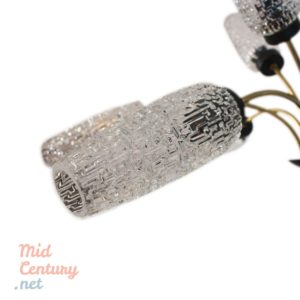
9 lights brass chandelier made in Italy, in the 1940s
Sold ItemsElegant yet spectacular 9 lights radial chandelier made in Italy, in the late 1940s or early 1950s. This radial chandelier features 9 arms made of brass with shades made of glass and black metal fixtures. It is in its original condition and displays all the major characteristics of International Style / Mid-Century design, alongside with reminiscences of Stile Liberty and Art Deco. An exquisite piece, resembling a bouquet of tulips. The chandelier is kept in good condition. Italy's Stile Liberty took its name from the British department store Liberty, the colorful textiles of which were particularly popular in Italy. Notable Italian designers included Galileo Chini, whose ceramics were inspired both by majolica patterns and by Art Nouveau. He was later known as a painter and a scenic designer; he designed the sets for two Puccini operas Gianni Schicchi and Turnadot. The Teatro Massimo in Palermo, by the architect Ernesto Basile, is an example of the Italian variant of the style, architectural style, which combined Art Nouveau and classical elements. The most important figure in Italian Art Nouveau furniture design was Carlo Bugatti, the son of an architect and sculptor, and brother of the famous automobile designer. He studied at the Milanese Academy of Brera, and later the Académie des Beaux-Arts in Paris. His work was distinguished by its exoticism and eccentricity, included silverware, textiles, ceramics, and musical instruments, but he is best remembered for his innovative furniture designs, shown first in the 1888 Milan Fine Arts Fair. His furniture often featured a keyhole design, and had unusual coverings, including parchment and silk, and inlays of bone and ivory. It also sometimes had surprising organic shapes, copied after snails and cobras.480 €480 € -
Sold out


Set of two Mid-Century table lamp made in Germany
Sold ItemsSet of two vintage table lamp from the 1950s, made in Germany. The base of the lamp is made of metal. The lampshades are made of glass. The items are in very good vintage condition.60 €60 € -
Sold out

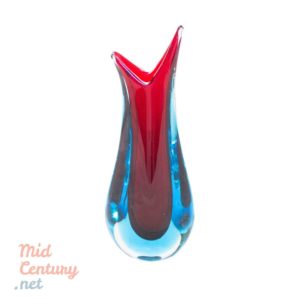
Beautiful Murano sommerso vase
Sold ItemsBeautiful Murano sommerso vase in red and blue. The piece is made in the 1960s and is kept in very good condition, showing no visible deterioration. When thinking of Murano glass, it is highly unlikely that we think of sand, yet this rare material is at the base of all glass production. Glass is firstly a mix of siliceous sand, soda, lime and potassium, which is put to melt inside an oven at a temperature of around 1.500 Celsius. After it has become flexible enough, it is removed with a pipe that will be used to blow the glass out while the glassmaker shapes and models it. The forms and colors given to each piece depend on the tools and chemicals used during its production. The techniques are also important.. One of the most common techniques is “Sommerso”, which in Italian literally means “submerged”. This technique is used to create several layers of glass (usually with different contrasting colors) inside a single object, giving the illusion of “immersed” colors that lay on top of each other without mixing. This is done by uniting different layers of glass through heat and repeatedly immersing them in pots of molten colored glass. This technique is quite recognizable: it is characterized by an outer layer of colorless glass and thick layers of colored glass inside it, as if a big drop of color had been captured inside the transparent glass. When one first sees these objects, it seems almost impossible to conceive such beautiful colors being locked so perfectly inside what would seem solid glass, and then undoubtedly one begins to wonder how ever did they manage to achieve such a complex game of shapes and colors right in the middle of a clear glass object. Source: glassofvenice.com110 €110 € -
Sold out
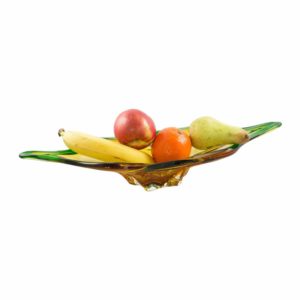
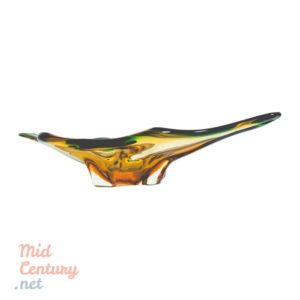
Green & brown Murano fruit bowl made in the 1950s
Sold ItemsGreen & brown Murano fruit bowl made in the 1950s. Of considerable size and, at the same time, remarked by the suppleness of its lines and silhouette, this fruit bowl (kept in very good vintage condition) can successfully be the central piece of any table. During World War II the industry did not thrive, but as soon as the war was over the glass masters of Murano returned to their art and created pieces deeply rooted in interior design trends of that time with focus on minimalism, functionality, and simplicity. To support these trends Murano artists and artisans returned to techniques of the past such as filigree, murrino, and lattimo. From that point onwards Murano saw continued exploration of styles and techniques striving to find a happy medium between the technical mastery and the outline, color, and decoration. The resulting continuous innovation led to a rise in popularity and to multiple prizes at various international art exhibitions. Thanks to such prominent artists as Archimede Seguso, Ludovico and Laura De Santillana, Tobia Scarpa, Ercole Barovier, Fulvio Bianconi, Toni Zuccheri, Romano Chrivi, Giampaolo Martinuzzi, and Alfredo Barbini, Murano again became known as the glassblowing capital of the world. Murano now created the art trends as opposed to following them in the years past. Source: glassofvenice.com110 €110 € -
Sold out


Smoky Menuet vase by Per Lütken
Sold ItemsSmoky glass vase, part of Menuet series, signed by Per Lütken and produced at Holmegaard. Signed, identified and dated on the bottom, “Holmegaard 19PL59” (Per Lütken signed almost always monogrammed with initials falling between the 4 digits of the year). Original label. Very elegant and stylish, the vase has the silhouette and the fragility of the heart ("Hjerte" form in Danish). The Menuet vases were originally produced between 1955-1974. But this spectacular piece was quickly beloved by the glassware enthusiasts and because of the steady demand, the model was reintroduced in production in 1985.60 €60 € -
Sold out
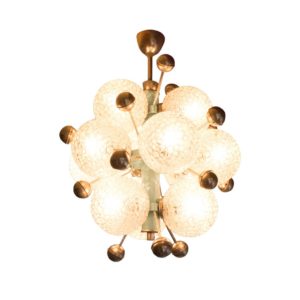
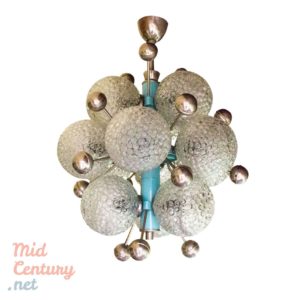
Spectacular Space Age / Atomic Age ceiling lamp with 12 lights
Sold ItemsSpectacular Space Age / Atomic Age ceiling lamp with 12 lights made in the 1960s. This chandelier features an elaborate design. The 12 spherical globes (lampshades) are made of robust, textured and partially flattened glass. The silver-colored decorative elements are made of metal; stylized in the form of 18 rays, they have spherical (globular) ends. The lights are arranged on three registers (3 up, 6 in the middle and 3 down). The piece is in very good condition and will look amazing in any modern home. The Space Age is a time period encompassing the activities related to the Space Race, space exploration, space technology, and the cultural developments influenced by these events. The Space Age is generally considered to have begun with Sputnik (1957). During the 1950s, architecture, furniture, interior design, cars, and gadget design took on a curiously spaceflight-inspired aesthetic.500 €500 € -
Sold out


Holmegaard decanter by Per Lütken
Sold ItemsSpirits bottle / decanter designed by Per Lütken in the 1970s and produced at Holmegaard, Denmark. Massive, towering, kept in good condition. Still bears the original label.60 €60 € -
Sold out


Kluk-Kluk decanter by Jacob E. Bang
Sold ItemsThe Kluk-Kluk decanter draws its name from the noise it makes when liquid is poured, noise that is amplified by this bottle. Initially used only for schnapps, this bottle is very popular in Denmark, and over time, it was produced by Holmegaard in a myriad of shapes, sizes, and colors. The first Kluk-Kluk designed by Jacob Bang was produced in 1928 but Bang kept revisiting the piece. This model was probably designed in the late 1950s or early 1960s and retains its original label.50 €50 € -
Sold out
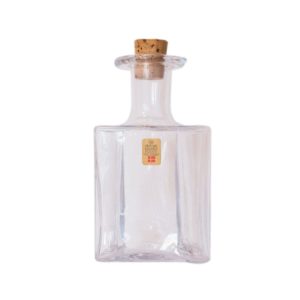

Hivert decanter made by Holmegaard
Sold ItemsThe Hivert decanter (also known as The Swig Jug) was designed by Holmegaard creative team in 1970 (by Hjørdis Olsen and Charlotte Rude). The shape is designed specifically for a strong handhold. Initially used only for schnapps, it is still suitable for any kind of spirits.40 €40 € -
Sold out


Murano orange fruit bowl
Sold ItemsImpressive fruit bowl made in Murano in the second half of the 1950s. The piece distinguishes itself through the transparency of the orange pigment, which goes up to red at certain times of the day when light is favorable. The irregular shape - of natural inspiration - radiates from the center. A rare piece, kept in excellent condition.110 €110 € -
Sold out


Drunken Kluk-Kluk decanter by Jacob E. Bang
Sold ItemsThis particular decanter, known as "the drunk" (because of its bent posture) is a variation of the famous Kluk-Kluk decanter which takes its name from the sound made by the liquid when poured, sound amplified by the shape of this bottle. Both the Drunken Kluk-Kluk and the classic Kluk-Kluk are very popular in Denmark and were produced by Holmegaard in a variety of shapes, sizes and colors. The first Kluk-Kluk designed by Jacob Bang dates from 1928 but the designer kept coming back to this. This piece presented above is designed in the second half of the 1950s.70 €70 €
