
-

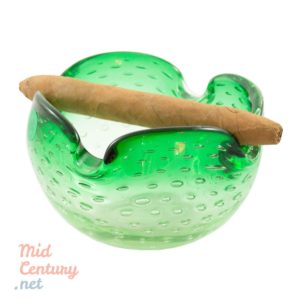
Controlled bubbles (bullicante) Murano ashtray
Glass & Ceramics, Home AccessoriesBeautiful controlled bubbles (bullicante) Murano ashtray made of glass. Hand blown, this piece displays a nice chromatic effect and goes from dark green (to the rim) to clear white (at the bottom). The quality and tradition that characterize Murano’s finest glass furnaces have always been worthy of the highest appreciation. This prestige is due mostly to the glass masters’ hard work and dedication, which are the very core of Murano’s most famous trade. Glassmaking has been passed on from one generation to the next one, with constant innovations and timeless originality. The loyalty and respect with which this trade is treated is possibly the key to Murano’s success. Glass masters all over the island have always worked with endless vitality, and this creative vein is evident in every glass artwork that comes out of any furnace, with improved techniques and bewildering effects. The “bullicante” effect is amongst the most famous glass making techniques and it is seen quite often around the island of Murano. If you’ve had the fortune of strolling along the streets of Venice, you would have noticed beautiful glass pieces with small air bubbles trapped in the inside, possibly stopping to wonder how that seemingly impossible effect is achieved. This peculiar effect is obtained by placing a piece of molten glass inside a metallic mold with spikes, very much resembling a pineapple’s texture. These spikes cause small holes on the surface creating a pattern all around the glass piece. After it’s been left to cool down for a few moments, the whole piece is submerged in molten glass again. This second layer completely covers the first one. However, thanks to the thick consistency of glass, the holes previously impressed on the first layer are not covered, thus causing air to be trapped between both layers of glass. This process can be repeated several times, creating a pattern as complicated as the glass master wishes. This technique gives not only a sense of depth to the whole object, but also an incomparable decorative effect, famous for its originality. Source: glassofvenice.com40 €40 € -
Sold out
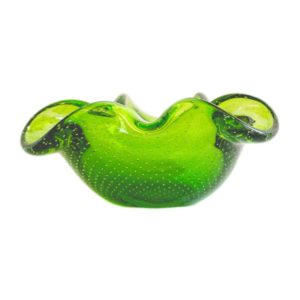

Green bullicante Murano ashtray
Sold ItemsBeautiful controlled bubbles (bullicante) ashtray made of glass in Murano, Italy, in the 1960s. Hand blown, this pice features the shape of a flower in an amazing shade of translucent emerald green. The quality and tradition that characterize Murano’s finest glass furnaces have always been worthy of the highest appreciation. This prestige is due mostly to the glass masters’ hard work and dedication, which are the very core of Murano’s most famous trade. Glassmaking has been passed on from one generation to the next one, with constant innovations and timeless originality. The loyalty and respect with which this trade is treated is possibly the key to Murano’s success. Glass masters all over the island have always worked with endless vitality, and this creative vein is evident in every glass artwork that comes out of any furnace, with improved techniques and bewildering effects. The “bullicante” effect is amongst the most famous glass making techniques and it is seen quite often around the island of Murano. If you’ve had the fortune of strolling along the streets of Venice, you would have noticed beautiful glass pieces with small air bubbles trapped in the inside, possibly stopping to wonder how that seemingly impossible effect is achieved. This peculiar effect is obtained by placing a piece of molten glass inside a metallic mold with spikes, very much resembling a pineapple’s texture. These spikes cause small holes on the surface creating a pattern all around the glass piece. After it’s been left to cool down for a few moments, the whole piece is submerged in molten glass again. This second layer completely covers the first one. However, thanks to the thick consistency of glass, the holes previously impressed on the first layer are not covered, thus causing air to be trapped between both layers of glass. This process can be repeated several times, creating a pattern as complicated as the glass master wishes. This technique gives not only a sense of depth to the whole object, but also an incomparable decorative effect, famous for its originality. Source: glassofvenice.com55 €55 €

Bullicante
Home » Bullicante