
-
Sold out


Murano sommerso vase from the 1950s
Sold ItemsBeautiful Murano sommerso vase in green and purple. The piece is made in the 1950s and is kept in very good condition, showing no visible deterioration. It has the original label. When thinking of Murano glass, it is highly unlikely that we think of sand, yet this rare material is at the base of all glass production. Glass is firstly a mix of siliceous sand, soda, lime and potassium, which is put to melt inside an oven at a temperature of around 1.500 Celsius. After it has become flexible enough, it is removed with a pipe that will be used to blow the glass out while the glassmaker shapes and models it. The forms and colors given to each piece depend on the tools and chemicals used during its production. The techniques are also important.. One of the most common techniques is “Sommerso”, which in Italian literally means “submerged”. This technique is used to create several layers of glass (usually with different contrasting colors) inside a single object, giving the illusion of “immersed” colors that lay on top of each other without mixing. This is done by uniting different layers of glass through heat and repeatedly immersing them in pots of molten colored glass. This technique is quite recognizable: it is characterized by an outer layer of colorless glass and thick layers of colored glass inside it, as if a big drop of color had been captured inside the transparent glass. When one first sees these objects, it seems almost impossible to conceive such beautiful colors being locked so perfectly inside what would seem solid glass, and then undoubtedly one begins to wonder how ever did they manage to achieve such a complex game of shapes and colors right in the middle of a clear glass object. Source: glassofvenice.com75 €75 € -
Sold out
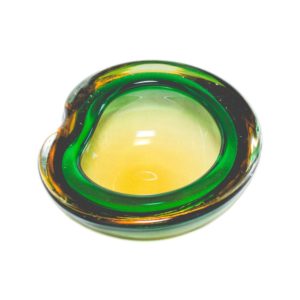

Green and brown bowl made in Murano, in the 1950s
Sold ItemsBeautiful geode bowl made in Murano, Italy, in the 1950s. Nicely colored, in shades of brown and green, this is a hand blown piece kept in very good vintage condition. Murano glass Geode bowls earn the name "geodes" due to their resemblance to geode rocks - rocks or stones that have been sliced neatly in two. The geode bowls therefore have a perfectly flat, wide rim. Murano glass geodes consist of two or more layers of cased glass. They were made my several Italian glass manufacturers from the Venetian island of Murano, and as such it is virtually impossible to identify the maker of an unmarked bowl. Popular geode shapes include circular, square, triangular, figure eight, and kidney shaped among others. Source: 20thcenturyglass.com50 €50 € -
Sold out
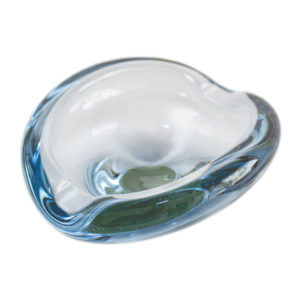

Beautiful Akva ashtray for two, by Per Lütken
Sold ItemsBeautiful Akva ashtray for two designed by Per Lütken for Holmegaard. This model is part of the Akva series, which was a huge success and remained in production for more than two decades between 1953 and 1974. A rare piece made from hand-blown glass. The Akva series includes items sold under different trade marks and line names: Askebaeger, Dukling, Fiona, Hellas, Lysestage, Menuet, Rondo, Selandia, Thule, Umanak, Surf etc.50 €50 € -
Sold out


Danish Minerva Daybed by Peter Hvidt & Orla Mølgaard-Nielsen for France & Son, 1957
Sold ItemsBeautiful late 1950s Danish modern daybed (Model Minerva), designed by Peter Hvidt & Orla Mølgaard Nielsen, produced by France & Son. The item features a teak wooden frame and renewed mustard upholstery. The minimalist look of this sofa is characteristic for the Scandinavian design of that era and can easily fit any contemporary interior.1.100 €1.100 € -
Sold out


Little green and pink table lamp
Sold ItemsBeautiful and suave Art Deco green and pink table made in Germany in the 1950s. The table lamp has a light green body, a brass tube and a pink lampshade made of plastic. It also has it's original switcher. The lamp is in full working order and in good vintage condition.80 €80 € -
Sold out


Beautiful Art Deco table made in the 1950s
Sold ItemsDisplaying Art Deco geometries, this elegant table is made of particle board and wood and features brown lacquered surfaces. Made in the 1950s in Germany, the table has an exquisite look. The sides are slightly trapezoidal and nicely decorated with different colored veneer. The tables is in good condition, although it displays some signs of use, small defects and scratches visible in the photos.150 €150 € -
Sold out

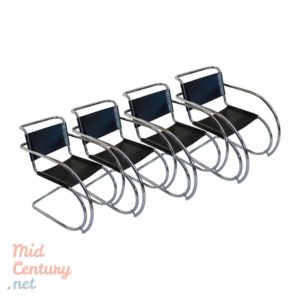
Set of 4 “MR” armchairs by Ludwig Mies van der Rohe
Sold ItemsSet of 4 "MR" armchairs by Ludwig Mies van der Rohe. The armchairs are made of tubular steel and black natural leather and are preserved in a very good shape. The architect and designer Ludwig Mies van der Rohe is one of the best-known exponents of International Style modernism. His "less-is-more" philosophy has become a catchphrase for much twentieth-century design, though a preference for luxurious and costly materials often underscores the deceptive simplicity of his elegant and refined designs. Mies van der Rohe was the last director of the Bauhaus design school in Dessau, from 1930 until its closing in 1932. In 1938 he left Germany for America, where he headed the architecture department at the Illinois Institute of Technology. The graceful, elegant, and beautifully proportioned "MR" armchair, developed from a 1924 design for a cantilevered chair by Mart Stam, was introduced by Mies van der Rohe at the 1927 Stuttgart exhibition and has remained in production ever since. The chair’s cantilevered design uses tubular steel, then a technological novelty, to create an intuitively accessible and ergonomic seat. (When asked why he created chairs with generously sized seats, Mies van der Rohe allegedly replied that he designs chairs he’d be most comfortable sitting in.) The MR Armchair is perfectly balanced, featuring the material innovation and lack of ornamentation that epitomize the International Style. It was awarded the Museum of Modern Art Award in 1977 and the Design Center Stuttgart Award in 1978. In 1968 the Knoll group took the license to manufacture these chairs but both before 1968 and afterwards many factories have in fact produced these iconic pieces.790 €790 € -
Sold out


Set of two Mid-Century table lamp made in Germany
Sold ItemsSet of two vintage table lamp from the 1950s, made in Germany. The base of the lamp is made of metal. The lampshades are made of glass. The items are in very good vintage condition.60 €60 € -
Sold out

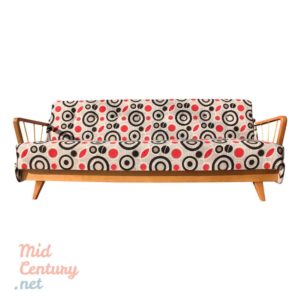
Beautiful Space Age sofa bed made in Germany
Sold ItemsSofa bed with radial armrests, made in Germany in the 1950s. The organic and delicate shapes are consistent with the German Modernism. The legs are flared. The piece is in a very good condition and was recently restored.500 €500 € -
Sold out
Bayard wall clock made in France
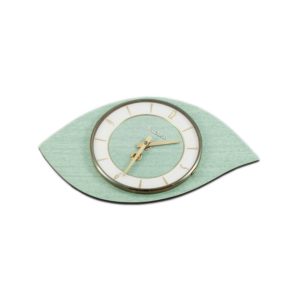
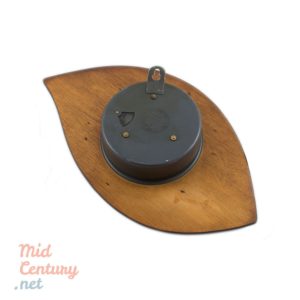
Sold ItemsBeautiful Bayard wall clock made in France in the 1950s. It features a laminated wood green case (Formica/Laminex) and an Art Deco dial. This clock can give a sophisticated touch to any room. This is a mechanical clock and has to be manually winded once a week to operate. It is in very good condition with only small age-related traces.50 €50 € -
Sold out


Table lamp made by Pfaffle Leucheten-Schwenningen
Sold ItemsBeautiful, minimalist table (desk) lamp made by Pfaffle Leucheten-Schwenningen in Germany, in the 1950s. This sober, geometric piece is distinguished by the elegance and rigor specific to German designers and makers. The lamp features nice sculptural lines through the double adjustable arm on a rectangular, discrete base.120 €120 € -
Sold out
Green & brown Murano fruit bowl made in the 1950s
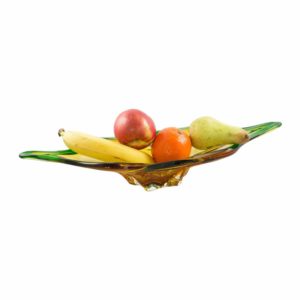
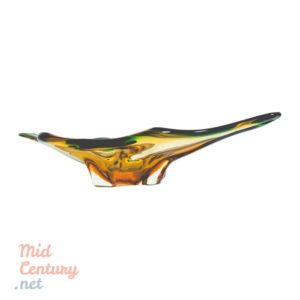
Sold ItemsGreen & brown Murano fruit bowl made in the 1950s. Of considerable size and, at the same time, remarked by the suppleness of its lines and silhouette, this fruit bowl (kept in very good vintage condition) can successfully be the central piece of any table. During World War II the industry did not thrive, but as soon as the war was over the glass masters of Murano returned to their art and created pieces deeply rooted in interior design trends of that time with focus on minimalism, functionality, and simplicity. To support these trends Murano artists and artisans returned to techniques of the past such as filigree, murrino, and lattimo. From that point onwards Murano saw continued exploration of styles and techniques striving to find a happy medium between the technical mastery and the outline, color, and decoration. The resulting continuous innovation led to a rise in popularity and to multiple prizes at various international art exhibitions. Thanks to such prominent artists as Archimede Seguso, Ludovico and Laura De Santillana, Tobia Scarpa, Ercole Barovier, Fulvio Bianconi, Toni Zuccheri, Romano Chrivi, Giampaolo Martinuzzi, and Alfredo Barbini, Murano again became known as the glassblowing capital of the world. Murano now created the art trends as opposed to following them in the years past. Source: glassofvenice.com110 €110 € -
Sold out
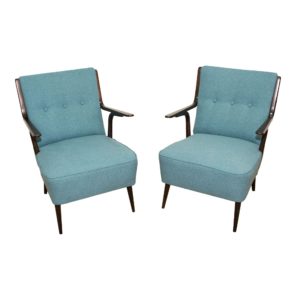

Beautiful pair of Mid-Century armchairs made in Italy in the 1950s
Sold ItemsBeautiful pair of Mid-Century armchairs made in Italy in the 1950s. Featuring incredibly refined and stylish wooden arm posts and legs, the armchairs have been recently restored and have new upholstery. Also, the strong contrast between the color of the upholstery and the dark wooden elements offers a sophisticated yet modern look. This pair is in great condition and can accommodate an elegant living room, hallway or salon.500 €500 € -
Sold out


Art Deco mantel clock in wood case
Sold ItemsBeautiful Art Deco mantel clock made in the 1950s. It features a very elegant wood case and a precise geometric game. It is in very good condition with only small age-related traces.100 €100 € -
Sold out


Smoky Menuet vase by Per Lütken
Sold ItemsSmoky glass vase, part of Menuet series, signed by Per Lütken and produced at Holmegaard. Signed, identified and dated on the bottom, “Holmegaard 19PL59” (Per Lütken signed almost always monogrammed with initials falling between the 4 digits of the year). Original label. Very elegant and stylish, the vase has the silhouette and the fragility of the heart ("Hjerte" form in Danish). The Menuet vases were originally produced between 1955-1974. But this spectacular piece was quickly beloved by the glassware enthusiasts and because of the steady demand, the model was reintroduced in production in 1985.60 €60 € -
Sold out
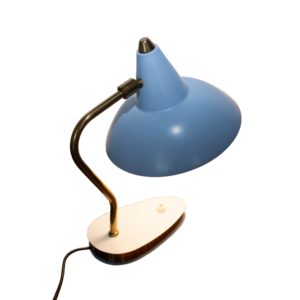
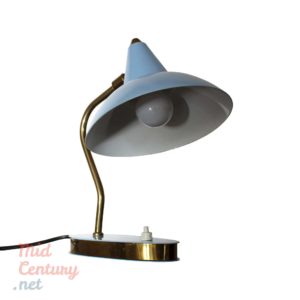
Charming Mid-Century table lamp
Sold ItemsCharming Mid-Century table lamp made of metal and brass. The table lamp features a beautiful contrast between the golden brass and the soft shade of blue. Made in the early 1950s, this piece is in very good condition displaying no deterioration. It also has the original lightbulb socket and switch.100 €100 € -
Sold out
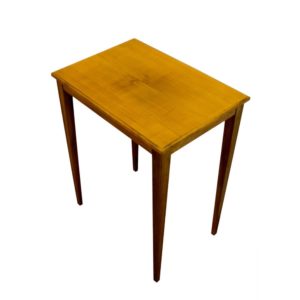

Cherry wood table made in Germany
Sold ItemsElegant cherry wood table made in Germany, in the mid 20th century. The tall and slim legs and the thin top, with beveled edges, give this table a special finesse. An example of the elegant, refined German taste. The table is in very good condition.100 €100 € -
Sold out

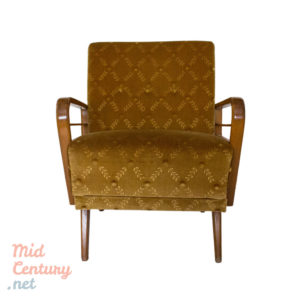
Space Age armchair made in Denmark
Sold ItemsBeautiful Space Age armchair made in Denmark in the 1950s. The piece is made of solid wood with natural cherry veneer treated with wax. The shape features the iconic Space Age design lines. The curved wood armrests, the oblique seat and the flattered legs are stylized in a manner specific to some of the best-known designers of that period, Charles and Ray Eames. The velour upholstery is typical for the 1950s and is attached to metallic targets. The Space Age is a time period encompassing the activities related to the Space Race, space exploration, space technology, and the cultural developments influenced by these events. The Space Age is generally considered to have begun with Sputnik (1957). During the 1950s, architecture, furniture, interior design, cars, and gadget design took on a curiously spaceflight-inspired aesthetic.300 €300 € -
Sold out


Imposing coffee table made of teak
Sold ItemsImposing coffee table made in Denmark, in the 1950s. Made of teak, one of the representative wood essences of Scandinavian Modern, this table has organic, natural lines, avoiding harsh shapes and sharp angles. The silhouette of the trapezoidal legs provides extra suppleness and make the table a stylish presence despite its robust construction. The piece is in very good condition and has impressive dimensions for a sofa table (170 cm. long). It can be the centerpiece of any living room.450 €450 € -
Sold out


Holmegaard decanter by Per Lütken
Sold ItemsSpirits bottle / decanter designed by Per Lütken in the 1970s and produced at Holmegaard, Denmark. Massive, towering, kept in good condition. Still bears the original label.60 €60 € -
Sold out
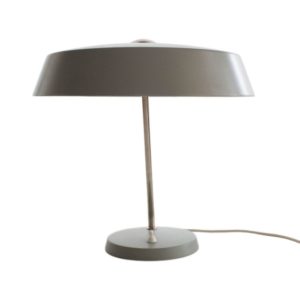
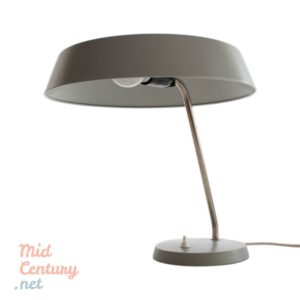
Gray desk lamp from the 1950s
Sold ItemsElegant gray desk lamp made in Germany. This piece was designed in the 1950s. Its outline is characteristic for the German Mid-Century design and for the sobriety that defines those products made in the first years after the end of World War II. With a large and spectacular shade, this lamp is a piece that can provide a unique personality to any office. With only small age-related traces, this desk light is in a very good vintage condition.120 €120 € -
Sold out


Armchair, Germany, 1950s
Sold ItemsArmchair with radial armrests, made in Germany in the 50s. The organic and delicate shapes are consistent with the German Modernism. The legs are flared. The piece is in a very good condition and was recently restored (new upholstery and stain).200 €200 € -
Sold out


Kluk-Kluk decanter by Jacob E. Bang
Sold ItemsThe Kluk-Kluk decanter draws its name from the noise it makes when liquid is poured, noise that is amplified by this bottle. Initially used only for schnapps, this bottle is very popular in Denmark, and over time, it was produced by Holmegaard in a myriad of shapes, sizes, and colors. The first Kluk-Kluk designed by Jacob Bang was produced in 1928 but Bang kept revisiting the piece. This model was probably designed in the late 1950s or early 1960s and retains its original label.50 €50 € -
Sold out
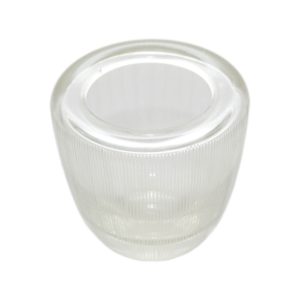

Rare Per Lütken from Unika series
Sold ItemsSpectacular and rare "Unika" series vase, signed by Per Lütken and produced at Holmegaard. Dated 1946, this crystal cut piece is made by sandblasting. This technique allowed that stylish vertical game of slim lines that defines this vase. Both the production date and the look put this piece between the Art Deco and Mid-Century aesthetics, being one of those objects that points the break with the past and the affirmation of a new style. The piece is not signed but - attention! - none of the the "Unika" vases were signed and - in this particular case - the lack of a signature is an additional guarantee of the authenticity of the piece.60 €60 € -
Sold out
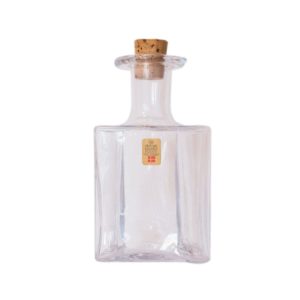

Hivert decanter made by Holmegaard
Sold ItemsThe Hivert decanter (also known as The Swig Jug) was designed by Holmegaard creative team in 1970 (by Hjørdis Olsen and Charlotte Rude). The shape is designed specifically for a strong handhold. Initially used only for schnapps, it is still suitable for any kind of spirits.40 €40 € -
Sold out


Murano orange fruit bowl
Sold ItemsImpressive fruit bowl made in Murano in the second half of the 1950s. The piece distinguishes itself through the transparency of the orange pigment, which goes up to red at certain times of the day when light is favorable. The irregular shape - of natural inspiration - radiates from the center. A rare piece, kept in excellent condition.110 €110 € -
Sold out


Drunken Kluk-Kluk decanter by Jacob E. Bang
Sold ItemsThis particular decanter, known as "the drunk" (because of its bent posture) is a variation of the famous Kluk-Kluk decanter which takes its name from the sound made by the liquid when poured, sound amplified by the shape of this bottle. Both the Drunken Kluk-Kluk and the classic Kluk-Kluk are very popular in Denmark and were produced by Holmegaard in a variety of shapes, sizes and colors. The first Kluk-Kluk designed by Jacob Bang dates from 1928 but the designer kept coming back to this. This piece presented above is designed in the second half of the 1950s.70 €70 €
